Job · DC lead pipe programs
DC lead pipe replacement programs, compared
DC Water and DOEE run four routes to replace a lead service line, from fully free to owner-paid private side; which one applies depends on what the map shows for each side of your property line.
Revised November 3, 2026 · who makes this map
| Place | What happens there | Turn to |
|---|---|---|
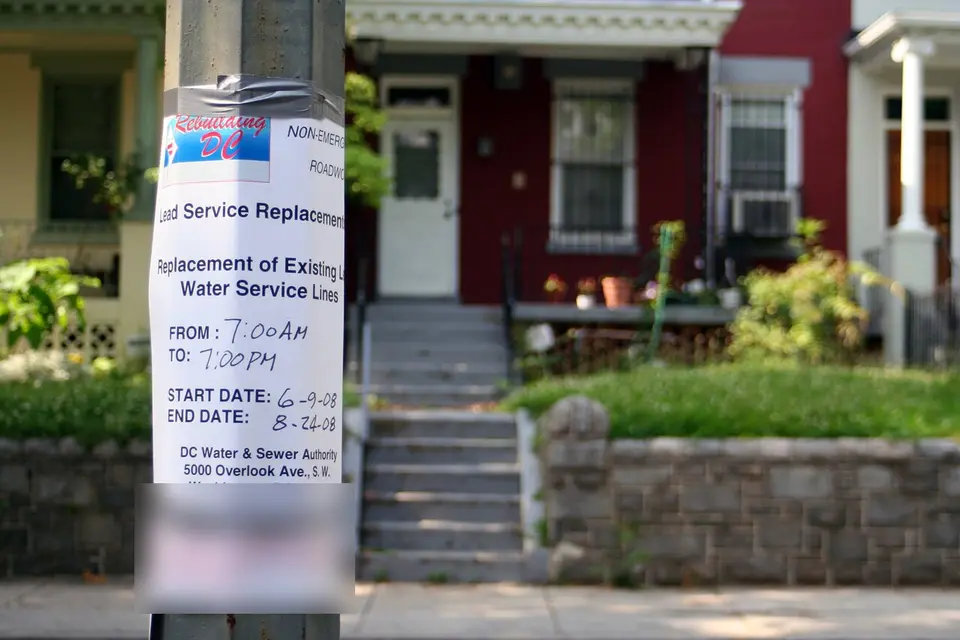
| Planned DC Water or DDOT project on your street | Private-side replacement is free if you sign a Right of Entry agreement. DC Water contacts owners and lists work on its Construction Dashboard. | Sheet 1 |
| Lead, galvanized or brass on your side only, non-lead in public space | LPRAP, run by DC Water and DOEE, uses non-ratepayer funds where available. DOEE says it currently covers the cost for enrolled homeowners. | Sheet 3 |
| Lead or galvanized on both sides, with a qualifying need or a leak | House by House Priority Full Replacement is free. Qualifying need: pregnant or nursing mother, child under 6, elevated blood lead, elevated water lead, or licensed child development facility. | Sheet 5 |
| Lead or galvanized on both sides, no project planned | The voluntary program: DC Water pays for public space and coordinates; you pay for private property. | Sheet 4 |
Step one: read the map
Search your address on DC Water's service line map. Blue means verified non-lead, green suspected non-lead, yellow no information, orange suspected lead, red verified lead. The map relies mostly on historic records, not confirmed ones. For green, yellow and orange properties DC Water says it will start a "dig and determine" test pit to confirm the material; for red, contact DC Water's lead team for help joining a program. The wider background is on lead service lines.
The four routes
Project-driven. DC Water replaces lead lines during capital work, emergency repair replacements and DDOT projects. If the owner completes the Right of Entry, the private side is done at no cost, in one visit with the public side. DC Water strongly encourages signing, because a whole line is replaced at once.
LPRAP. This is the Lead Pipe Replacement Assistance Program. It applies when the private side is lead, galvanized or brass and the public side is not. The owner or an authorized representative applies and agrees to use an LPRAP-approved contractor. DOEE's page says to be ready with the owner's photo ID and proof of ownership, and notes a new application form from October 2026 meant to simplify the process. An Approved Contractor List for FY27 is posted on DOEE's page.
House by House Priority. Free replacement of both sides, funded mainly by federal infrastructure grants for private-side work and DC Water's capital program for public-side work, subject to funding. You qualify if both sides are lead or galvanized and you have a qualifying need, or if a lead or galvanized private line is leaking or broken.
Voluntary. If both sides are lead and no capital project is planned, you can enroll. DC Water pays and coordinates the public work; you hire and pay for private work, either with a private plumber or the DC Water contractor. DC Water does not endorse or require its contractors.
Who is not eligible for the voluntary route
The voluntary program excludes streets with a capital project planned in the next two years, because you will be served by that project instead. It also excludes streets on DDOT's Asset Management List, which carry a five-year moratorium on construction. Properties under renovation may not qualify when DC Construction Codes require a water service pipe upgrade; in that case the owner may have to finance replacement in both private and public space. DC Water needs documents showing the private-side material: photos, a plumber's or home inspector's report, or a qualified professional's statement. Do not cut or disturb the pipe to make a photograph.
A private plumber must obtain an approved permit and coordinate with the DC Water contractor. Permit rules are on permits by place.
After replacement
DC Water publishes flushing instructions for after replacement; follow the ones for your address.
Tenants, sellers and buyers
Requests must come from the property owner. DC Water encourages tenants to ask the owner to call Customer Service at 202-787-4044. District law requires landlords to tell tenants whether the property has any known lead pipes and the results of lead testing. Owners must give the same disclosure to potential buyers before a sale.
Where to ask
Lead Free DC is the joint contact: 202-787-4044. Letters can go to the Lead Pipe Replacement Program, DC Water, 301 Bryant St NW, Washington, DC 20001. Place-by-place sheets for DC include Capitol Hill and Bloomingdale and LeDroit Park.
Check your own address
- Search your address on the DC Water lead map and note the color for the private and public sides.
- If your street appears on the Construction Dashboard, wait for the DC Water contact before paying for private-side work.
- Gather photo ID and proof of ownership before you open the new application form.
- If the public side shows non-lead and yours does not, apply through LPRAP; if both are lead, ask about House by House Priority first.
- Ask what the permit and inspection steps are before any private plumber starts.
Survey notes: sources for this page
- DC Water: lead pipe replacement programs. Opened November 3, 2026.
- DC Water: customer initiated full lead replacements. Opened November 3, 2026.
- DC Water: let us help you find out. Opened November 3, 2026.
- DOEE: Lead Pipe Replacement Assistance Program. Opened November 3, 2026.