Job · Cast-iron drains
Old cast iron drains: what the sources support
None of the official pages we opened discusses cast iron drains by name; they do say old lines can settle, crack and take on roots, and that owners generally maintain the lateral and the house drain.
Revised November 3, 2026 · who makes this map
| Place | What happens there | Turn to |
|---|---|---|
| DC | DC Water's backup page lists settling soil, joints that have slipped out of line, roots, collapses and grease. Lateral clearing is the owner's bill, through a registered master plumber. | Sheet 1 |
| Arlington | County code makes the lateral the owner's. We found nothing on cast iron. | Sheet 6 |
| Alexandria | Ownership turns on installation date, with July 1, 1955 as the dividing line. The city's sewer rehabilitation work has covered Del Ray. | Sheet 9 |
| Fairfax County | The county page puts the full lateral, public easement stretch included, on the owner, and asks you to ring it first if the main may be at fault. | Sheet 17 |
| Falls Church, Vienna, Herndon, City of Fairfax | Herndon puts the lateral from the property line to the building on the owner, Vienna the connection from main to building, and the City of Fairfax all the way to the main. Falls Church's rule is unconfirmed. | Sheet 16 |
What we can and cannot say
Cast iron is a drain material, and plenty of older houses may have some. We found no DC, county or city page that says how common it is here, how long it lasts, or how to judge its condition. So we do not give ages, lifespans or prices. A plumber with a camera is the only way to know what a particular line looks like.
What the sources do cover is the behaviour of old drain and sewer lines of any material.
What old lines do
DC Water says settling soil, slipped joints, roots, collapses and grease all cause sewer backups, and that the combined-sewer part of the District sees more of them. Fairfax County says roots enter open joints or cracks, can break a line and let debris build up, and that the owner may need to have roots cut again. The county names replacement with new plastic pipe as one way to stop roots entering.
None of that is a diagnosis of cast iron. It is a list of what goes wrong with joints and old runs. Read it as a reason to get a camera inspection before spending money.
Who pays
In every jurisdiction we checked, the drain inside the house is the owner's, and the lateral is the owner's for at least part of its run. See who owns which pipe for the split in each place. Alexandria is the one with a date test, tied to 1955. Insurance is separate: the Fairfax County page says a standard homeowners' policy leaves the lateral out, so read yours.
If a main is suspected, call the utility first: DC Water on 202-612-3400, Arlington on 703-228-6555, or the county's Customer Communications Center in Fairfax on 703-323-1211. DC Water generally does not pay cleanup or damages; claims go to 202-787-2052.
Replacement and repair
Joining new pipe to old is work for a licensed plumber. Nothing here is a how-to.
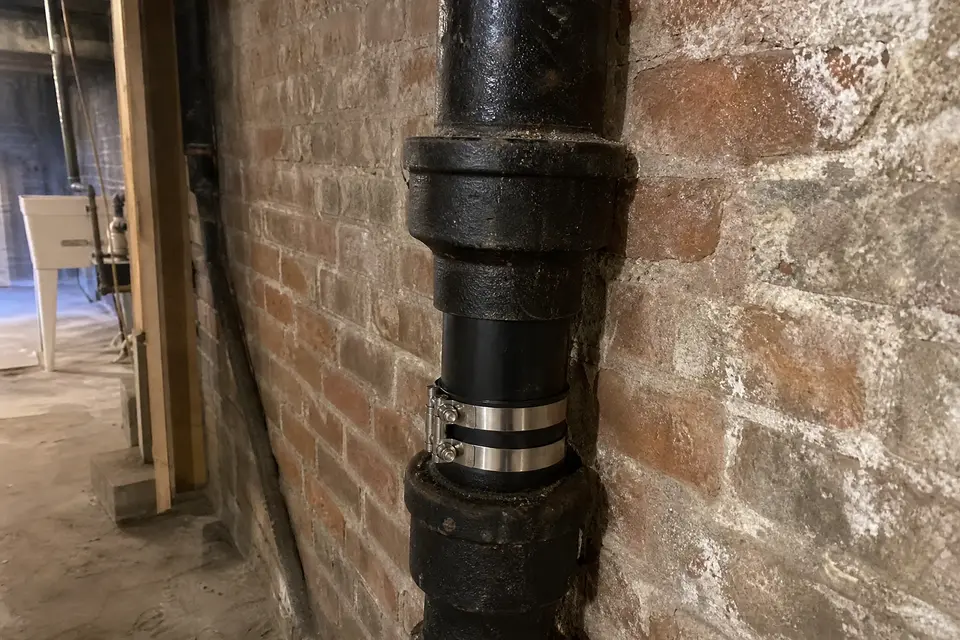
Plumbers often join new pipe to old cast iron with these: no-hub fittings at PlumbingSupplyAndMore (that store has the same owners as this map).
Repairs to a lateral need permits and 811, and in some places a permit from the road authority; see sewer lateral repair and digging and 811. If sewage has backed up, stop using drains, keep clear of the sewage, and keep people and pets away; read basement backups.
Rebates that may fit
Alexandria reimburses up to 50 percent, up to $2,000, of a licensed plumber's backflow preventer; the city page was updated April 2, 2026. DC Water's backwater valve rebate is for combined-sewer owners with a documented backup. Neither pays to replace drains.
Check your own address
- Ask the plumber for camera footage of the line and a written note of the material and where cracks or offsets are.
- Ask whether the problem is inside the house, in the lateral on your side, or in the public portion.
- In DC, hire a registered master plumber; check the license on DLCP's lookup.
- Read your homeowners' policy for water backup and service line coverage before work begins.
- If unsure, call a licensed pro before opening floors.
Survey notes: sources for this page
- DC Water, sewer backup. Opened November 3, 2026.
- Fairfax County, preventing backups and overflows. Opened November 3, 2026.
- Fairfax County, residential wastewater. Opened November 3, 2026.
- Alexandria sewer and hydrant maintenance. Opened November 3, 2026.
- Alexandria backflow preventer assistance. Opened November 3, 2026.
- Arlington County, sewer. Known to us only from a search listing of the page; the site would not open for us.
- Town of Herndon, water and sewer. Known to us only from a search listing of the page.; not opened.
- Town of Vienna, water and sewer agreement. Known to us only from a search listing of the page.; not opened.
- City of Fairfax, wastewater lateral repair program. Known to us only from a search listing of the page.; not opened.